
Google Universal Cart & UCP Explained: Is Your E-Commerce Store Ready for Agentic Checkout?
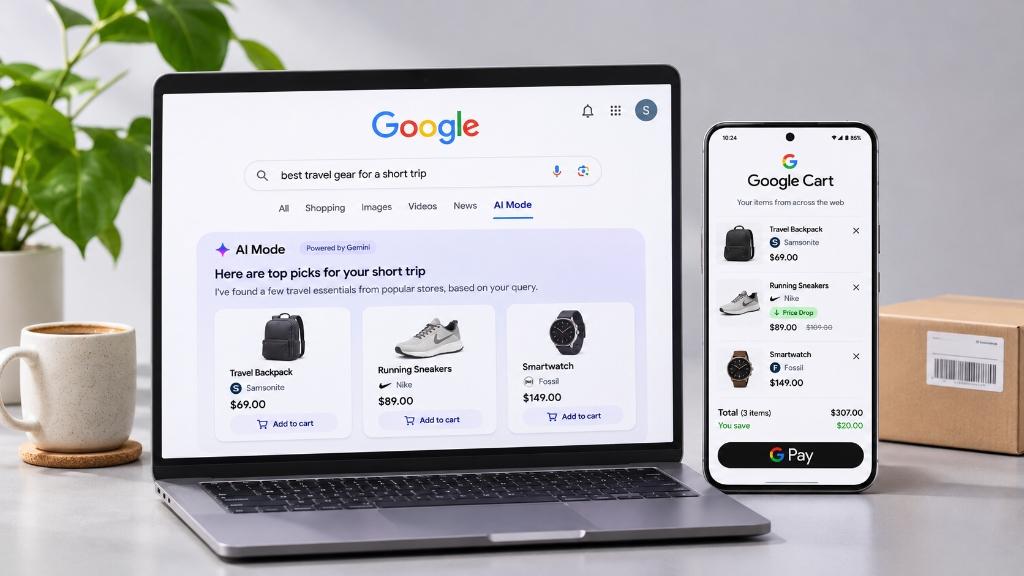
For the last two decades, e-commerce followed one predictable path: a customer searches on Google, opens five different browser tabs, compares prices, adds items to a website cart, and—more than 70% of the time—abandons the checkout before paying.
That workflow has fundamentally changed. With the rollout of Google Universal Cart across Google Search (AI Mode) and the Gemini app, discovery and checkout are merging into a single conversational screen. Powered by the open-source Universal Commerce Protocol (UCP) and Google's 60-billion-product Shopping Graph, shoppers can now research products, build a multi-retailer basket, track price drops, and check out without jumping across a dozen websites.
For e-commerce brands, D2C exporters, and retail businesses, this isn't just a consumer feature update—it is an architectural shift. If an AI shopping agent cannot read your product data, verify your real-time inventory, or communicate with your checkout API in under a second, your store becomes invisible at the exact moment a customer is ready to buy.
Below is a breakdown of how Google Universal Cart works under the hood, why the Universal Commerce Protocol (UCP) matters, and how our engineering and AI SEO teams at Infonode Technologies help businesses prepare their digital storefronts for agentic commerce.
What Is Google Universal Cart? (And How Does It Work?)
Google Universal Cart is a persistent, AI-powered shopping basket built directly into Google Search (AI Mode) and the Gemini app, with expansion across YouTube and Gmail. Instead of forcing shoppers to visit separate websites to remember what they liked, Universal Cart allows users to save products from multiple merchants into one unified cart while they browse or chat with Gemini.
Behind the scenes, Universal Cart acts like a personal shopping agent:
- Cross-Retailer Basket Building: Shoppers can compare a running shoe from one brand, a jacket from a Shopify store, and accessories from another retailer in a single view.
- Proactive Price & Restock Monitoring: If an item goes out of stock or drops in price, Google's Shopping Graph automatically updates the cart and notifies the user.
- Automated Deal & Wallet Optimization: At checkout, Universal Cart pulls in eligible merchant promo codes, loyalty perks via OAuth 2.0 identity linking, and Google Wallet credit card reward recommendations.
- Brand Control (Merchant of Record): Regardless of whether the user completes the purchase natively on Google or transfers the cart to your website, your business remains the Merchant of Record. You retain full ownership of customer data, order fulfillment, and the post-purchase relationship.
Under the Hood: Understanding the Universal Commerce Protocol (UCP)
To make instant checkout work across millions of independent online stores without locking merchants into a traditional closed marketplace, Google co-developed the Universal Commerce Protocol (UCP) alongside industry leaders including Shopify, Stripe, Visa, Mastercard, and major global retailers.
UCP is an open technical standard (/.well-known/ucp) that gives AI agents a common, machine-readable language to verify inventory, calculate taxes, apply promotions, and execute transactions securely.
When a shopper is ready to buy from your store inside Google Universal Cart, UCP supports two primary technical paths:
| Feature / Aspect | Path 1: UCP Native Checkout | Path 2: UCP Cart Transfer API (dev.ucp.shopping.cart) |
|---|---|---|
| How the User Checks Out | The shopper pays directly inside Google Search or Gemini using Google Pay / tokenized credentials. | The shopper clicks "Checkout on Merchant" and lands directly on your website's pre-populated cart page. |
| Technical Mechanism | Full UCP payment handler, tax calculation, and order lifecycle API integration (or native Shopify UCP toggle). | Google fires a single POST /carts (CreateCart) payload with all accumulated line_items, and your server returns a continue_url. |
| Upsell & Cross-Sell Control | Handled via Google's conversational Business Agent and Direct Offers in Merchant Center. | Full control on your own website checkout page to show bundles, add-ons, and custom branding. |
| Performance Requirement | Real-time feed accuracy and tokenized payment webhook reliability. | Sub-second API latency: Google strongly recommends your POST /carts endpoint respond in under 1 second (< 1000ms). |
Why Universal Cart Changes E-Commerce SEO Into GEO (Generative Engine Optimization)
In traditional e-commerce SEO, ranking on page one for a keyword like "best waterproof trekking backpack" was enough to win the click. Once the user landed on your product page, your photos and UI did the selling.
In AI Mode and Gemini, the AI reads the product data for the user and recommends 2 to 3 specific products directly inside the chat—complete with an "Add to Cart" button.
If your product catalog relies on thin descriptions, missing attributes, or outdated stock counts, the AI will skip your store in favor of a competitor whose data is machine-readable. To win visibility in Universal Cart, businesses must shift from basic keyword SEO to Answer Engine Optimization (AEO) and Generative Engine Optimization (GEO):
- 95%+ Attribute Completion in Google Merchant Center: AI shopping agents filter products based on natural-language prompts (e.g., "Show me a lightweight carry-on bag under ₹8,000 that fits overhead bins and ships in 3 days"). Every missing dimension, material tag, GTIN, or shipping policy in your feed disqualifies your product from that conversation.
- Conversational Context & Rich Schema: Beyond price and availability, structured Product JSON-LD schema must clearly define compatibility, usage scenarios ("best for"), variant relationships, and verified customer return policies.
- Bridging the Analytics Blindspot: Because shoppers can now discover and add items to a cart on Google without triggering a traditional session on your website, standard "browse abandonment" popups won't fire. Marketers need to track Google Merchant Center's AI Performance Insights (which is already live in India, the US, UK, Canada, and Australia) alongside GA4's AI Assistant channel to measure AI share-of-voice.
What Does This Mean for Businesses in India & Kerala?
While Google's consumer-facing Universal Cart checkout launched first in the U.S. (with Canada, Australia, and the U.K. next in line), waiting to upgrade your digital infrastructure is a costly mistake for two reasons:
- For Indian D2C & Cross-Border Exporters: If you sell apparel, spices, handicrafts, electronics, or wellness products globally to U.S. or international buyers via Shopify or custom storefronts, your competitors are already enabling UCP and Cart Transfer today.
- For Domestic Retailers, Restaurants & Hospitality Brands: Google has already rolled out AI Performance Insights in India inside Merchant Center and officially opened the UCP waitlist for Local Food Delivery and Lodging (Hotels).
Whether you run a growing multi-branch retail brand or a modern restaurant using cloud systems like our Zapito Restaurant POS Software, the line between local discovery and instant AI ordering is disappearing. Businesses with clean, API-driven cloud inventory and real-time menu/catalog syncing will be the first to capture direct AI orders without paying massive third-party aggregator commissions.
The 4-Step Universal Cart & UCP Readiness Checklist
To make your e-commerce store ready for AI-driven shopping and instant checkout, our engineering and digital marketing teams recommend a four-step technical audit:
- Audit Your Google Merchant Center Diagnostics: Eliminate all critical feed warnings. Verify that your return policies, regional shipping rates, GTINs, and high-resolution product images (minimum 1500x1500px) are 100% populated.
- Upgrade Your Structured Data (JSON-LD): Ensure your product pages output clean, server-rendered schema markup so AI crawlers from Google, ChatGPT, and Perplexity can parse variants, live pricing, and stock status without executing heavy client-side JavaScript.
- Connect Real-Time Inventory Sync: Because Universal Cart alerts users to restocks and price drops in the background, your ERP, POS, or warehouse database must sync with your online store and Merchant Center in real time—preventing cancelled orders that hurt your merchant trust score.
- Prepare Your UCP / Cart Transfer Endpoints: If you are on Shopify, audit your store's native UCP checkout eligibility. If you run a custom Next.js, Node.js, or headless e-commerce stack, prepare your
/.well-known/ucpprofile and build a low-latencyPOST /cartsendpoint capable of sub-second cart creation.
Frequently Asked Questions (FAQ)
When did Google Universal Cart launch?
Google first previewed Universal Cart and the Universal Commerce Protocol (UCP) at Google I/O on May 19, 2026, and rolled out the consumer experience in the U.S. on October 15, 2026, across Google Search (AI Mode) and the Gemini app. International expansion and new verticals like food delivery and hotel bookings are actively rolling out.
Do merchants lose customer data when someone buys through Google Universal Cart?
No. Under the Universal Commerce Protocol (UCP), the retailer always remains the Merchant of Record. You retain full ownership of the transaction, customer details, order fulfillment, and post-purchase communication.
What is the difference between UCP Native Checkout and the Cart Transfer API?
UCP Native Checkout allows the shopper to complete payment directly inside Google Search or Gemini using tokenized payment credentials. The Cart Transfer API (POST /carts) allows the shopper to build their basket on Google and transfer all items in a single click to a pre-populated checkout page on your own website.
How can my business track traffic and sales from Google AI Overviews and Universal Cart?
Merchants can track AI visibility using the AI Performance Insights report in Google Merchant Center (available in India, the U.S., Australia, Canada, and New Zealand) to see share-of-voice in organic AI answers, alongside the UCP analytics dashboard and Google Analytics 4 (GA4) AI referral channels.
Ready to Build an AI-Ready E-Commerce Store?
At Infonode Technologies, we don't just build websites—we engineer high-performance digital commerce systems built for how customers actually search and buy in 2026. From headless Next.js and custom e-commerce development to API system integrations and AI SEO / GEO optimization, our team in Kannur, Kerala helps brands scale locally and globally.
- Need a fast, scalable online store? Explore our E-Commerce Development Services.
- Want your brand recommended by Google AI, ChatGPT, and Gemini? Talk to our Digital Marketing & AI SEO Team.
- Looking to connect your POS, ERP, and online inventory in real time? Check out our System Integration Services.